
You have a report to finish, emails waiting, an appointment to organise, and a project you have been meaning to start for weeks. Someone sends you another request, your phone lights up, and suddenly even choosing where to begin feels like work.
You are not doing nothing because you do not care. You may be caught in the overwhelm cycle.
What the overwhelm cycle looks like
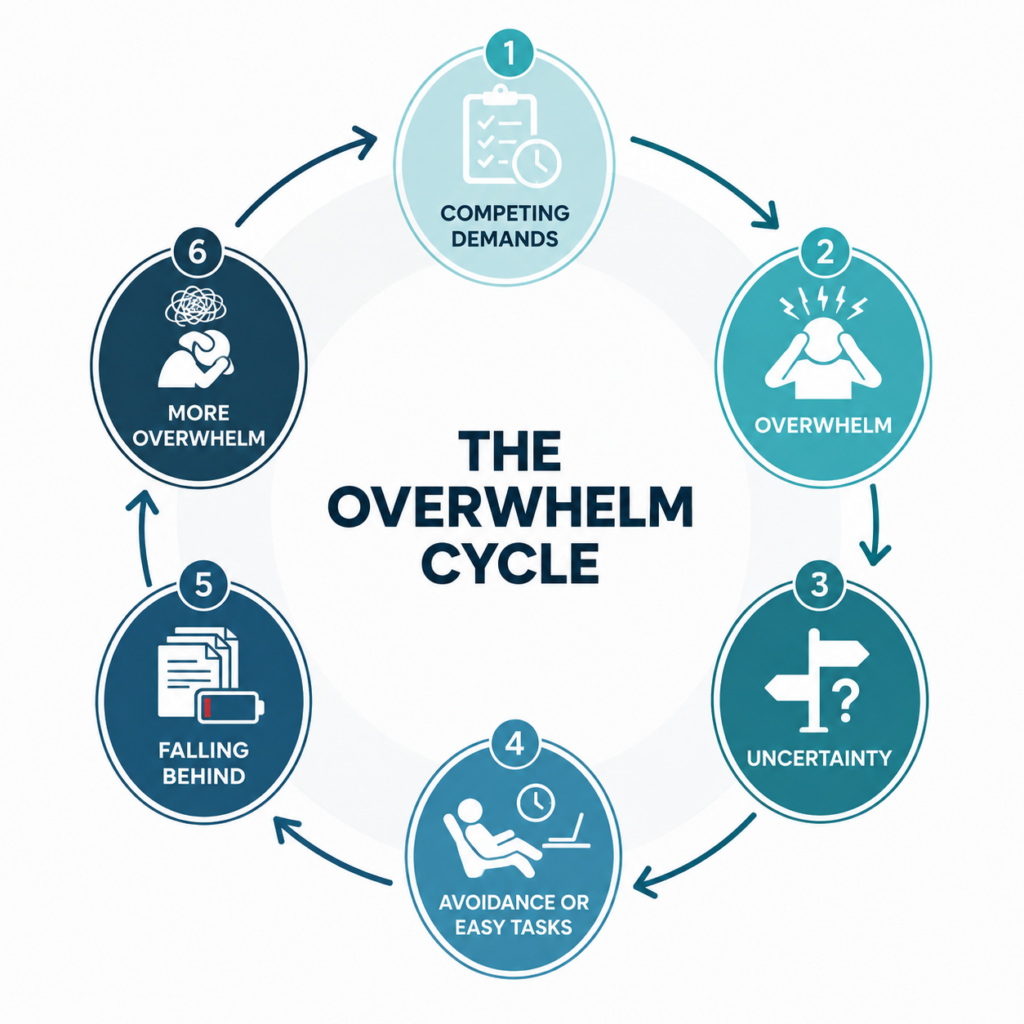
The cycle usually begins with competing demands. Several tasks feel important, urgent, uncomfortable, or overdue.
Because you cannot immediately tell which deserves attention first, you hesitate. You may procrastinate, scroll, reorganise your list, or complete a low-effort job for the relief of ticking something off.
The important work remains. That creates guilt and increases the pressure, which makes it even harder to begin.
The cycle looks like this:
Competing demands → overwhelm → uncertainty → avoidance or easy tasks → falling behind → more overwhelm
Telling yourself to “try harder” rarely solves the problem. You need to reduce the number of decisions competing inside your head.
Step 1: Get the work out of your head
Your brain is not a reliable storage system for an entire workload. Trying to remember everything keeps each task mentally active.
Begin with a complete task dump. Write down every job, reminder, commitment, and unfinished piece of work currently demanding attention.
Do not organise the list yet. Your first goal is simply to capture it.
People are often surprised at this point. The workload may still be substantial, but it usually feels less threatening once it is visible. A vague sense of “everything” has become a finite list.
Step 2: Separate importance from noise
For each task, ask:
- Does this contribute to an important goal?
- Is this one of my key responsibilities?
- What will happen if I do not complete it?
- Will it still matter next week or next month?
An important task creates meaningful progress or carries significant consequences if ignored.
Be careful not to confuse emotional discomfort with importance. A difficult email may occupy your thoughts because you do not want to send it. That does not automatically make it your highest priority—although a real deadline or another person’s dependence on your response might.
Step 3: Test whether urgency is real
An urgent task needs attention soon because waiting will create immediate consequences.
Ask:
- Does this genuinely need to be done today?
- Is there a real deadline?
- Is someone unable to continue until I act?
- What changes if this waits until tomorrow?
Notifications create a sense of urgency without proving that urgency exists. So can another person’s impatience.
You do not have to ignore requests. You do need to assess them before allowing them to replace your existing priorities.
Step 4: Choose one next action
“Complete the project” is not a useful next action. It describes an outcome, not a starting point.
A next action should be small and observable:
- Open the project brief and identify the required sections.
- Call the client to confirm the deadline.
- Draft the first three headings.
- Find the figures needed for the report.
When a task feels too large, keep breaking it down until the first step feels possible.
You do not need enough motivation to complete the whole project. You only need enough to begin the next action.
Step 5: Create a top three
Choose three tasks that would make today worthwhile.
These are not necessarily the three quickest jobs. They are the tasks that best combine consequence, responsibility, and meaningful progress.
Your top three creates a boundary around the day. Other work may still be completed, but it no longer determines whether you consider the day a success.
If three substantial tasks are unrealistic, choose one major priority and two smaller supporting actions.
Step 6: Protect the first work block
Set aside a defined period for your first priority. During that time:
- Silence non-essential notifications.
- Close your inbox.
- Put your phone out of reach if possible.
- Let relevant people know you are unavailable.
- Capture new requests rather than immediately acting on them.
Switching attention carries a cost. Research summarised by the American Psychological Association shows that repeatedly shifting between tasks can reduce efficiency. Protecting attention helps you use the time you already have more effectively.
Step 7: Review without punishing yourself
At the end of the day, do not begin with what remains unfinished.
Ask:
- What did I complete?
- What moved forward?
- What did I learn about the time this work requires?
- What genuinely needs to carry over?
This is not empty positive thinking. It is an accurate review. If you completed the day’s most important task, saying “I only finished one thing” minimises the work that mattered most.
When the workload itself is unreasonable
Prioritisation is not a magic solution for chronic understaffing, excessive workloads, or unclear management expectations.
If every task carries serious consequences and there is genuinely not enough time or capacity, the next priority may be a conversation about resources, deadlines, responsibilities, or risk.
A planning tool should help you see an unreasonable workload more clearly. It should not be used to blame yourself for being unable to perform the work of several people.
Start by creating clarity
When you are overwhelmed, you do not need to solve the entire week at once.
Get the work out of your head. Decide what matters. Test what is genuinely urgent. Choose one next action and protect enough time to begin it.
Small progress creates evidence that you can move forward. That evidence builds momentum, and momentum begins to turn the overwhelm cycle in the other direction.
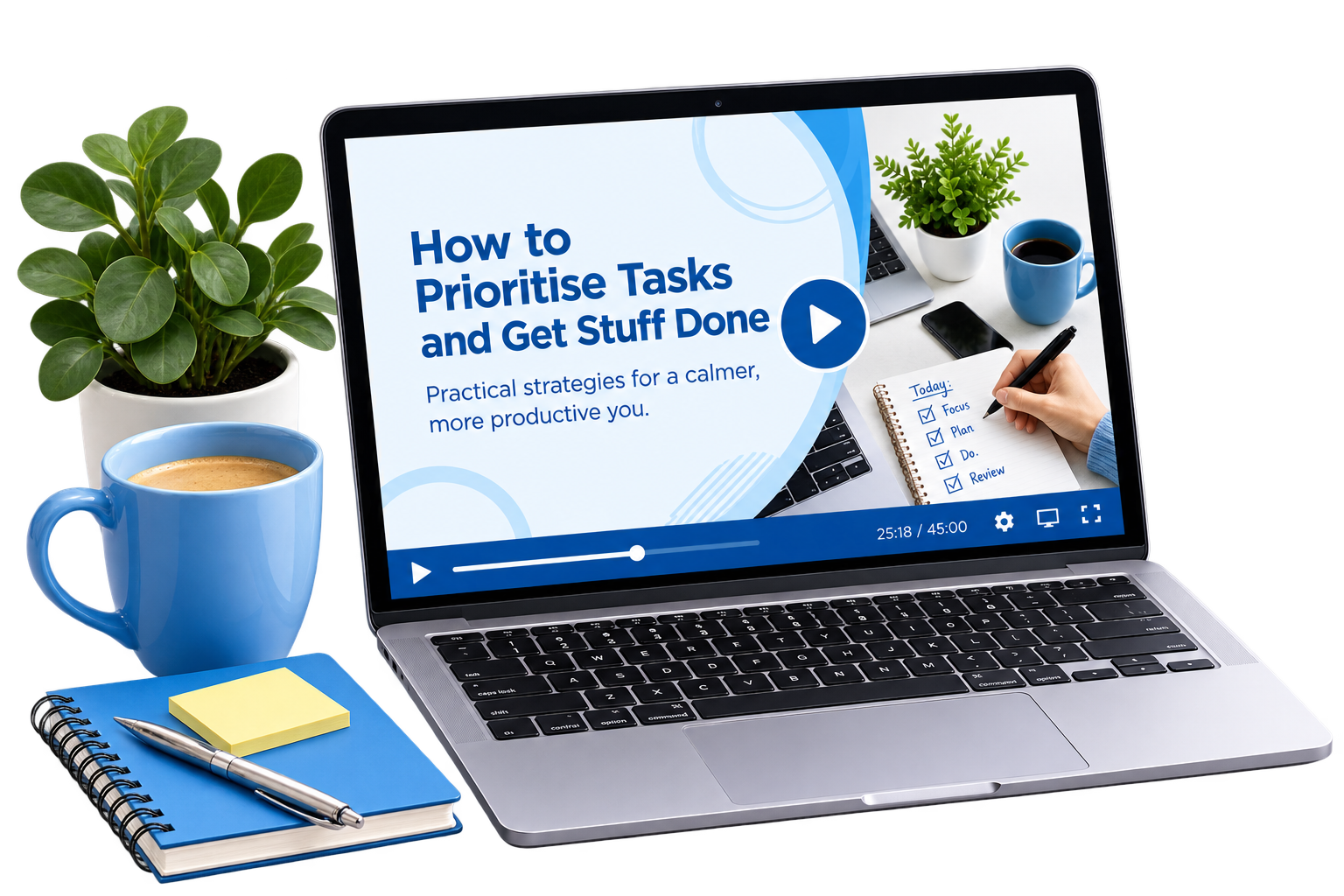
FREE ON-DEMAND WEBINAR
How to Prioritise Tasks and Get Stuff Done
Feeling overwhelmed by competing priorities?
When everything feels urgent, it is easy to jump from task to task, finish very little and end the day feeling even more overwhelmed. This free 45-minute on-demand webinar gives you a practical framework to cut through the noise, decide what deserves your attention first and focus on what matters most.