
We help organisations build calm, confident, and competent responses to mental health challenges at work.
Practical, trauma-informed training that helps workplaces prevent mental health harm and respond well when challenges arise.
When mental health issues show up at work, most people aren’t sure what to do.
You can feel the pressure building.
Stress is higher. People are burning out. Conversations feel heavier. Someone might have already said they’re not coping, and now you’re wondering what happens if things escalate.
You want to do the right thing.
But mental health at work is messy, emotional, and easy to get wrong. There’s no clear script. Managers second-guess themselves. HR ends up carrying the risk. Leaders worry about saying too much, or not enough.

Doing nothing doesn’t feel responsible.
Reacting without the right skills can make things worse.
Workplaces don’t need more awareness.
They need calm, capable people who know how to respond — before issues turn into crises.
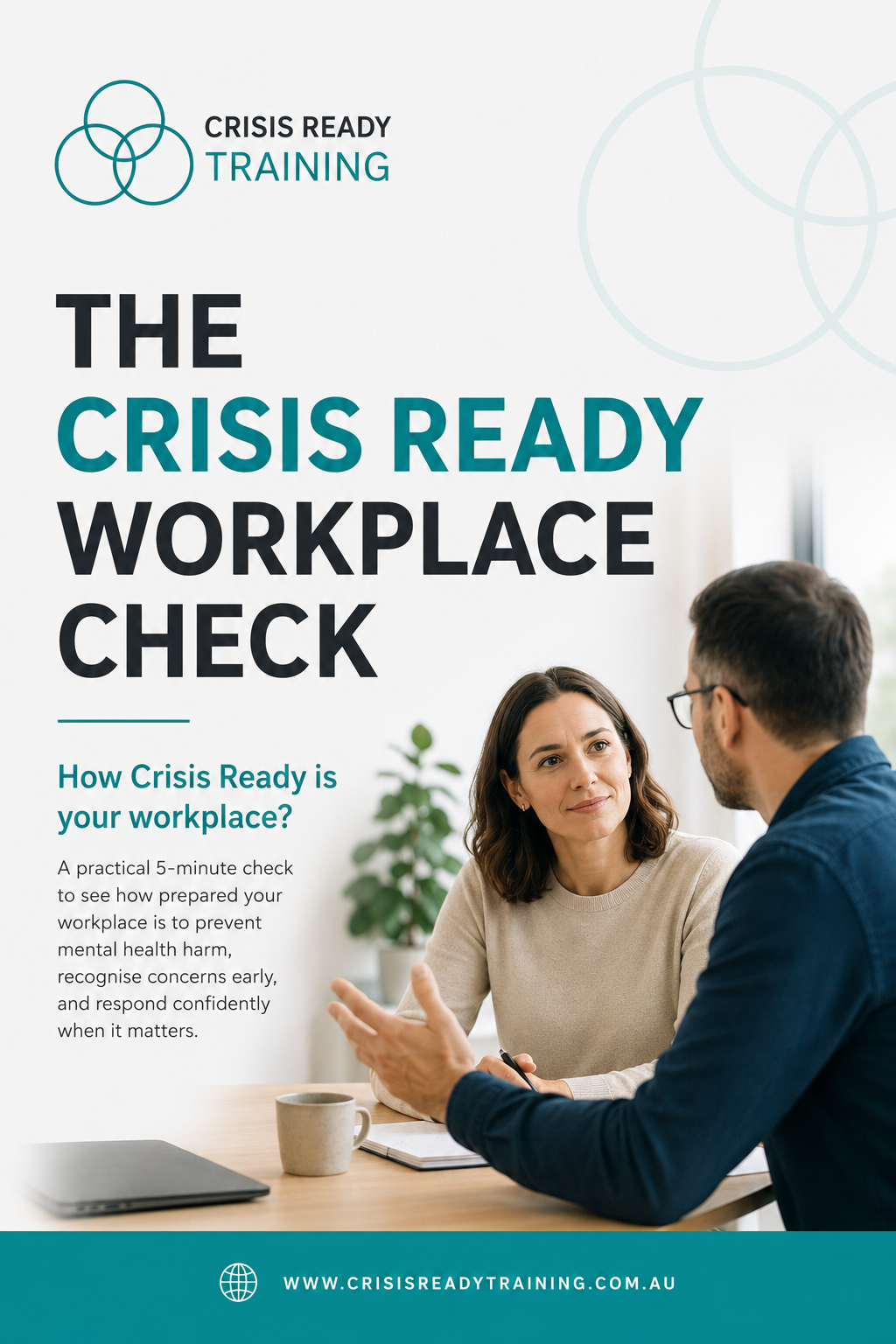
Is Your Workplace Crisis Ready?
Discover where your workplace is prepared and where there may be gaps. Get the free Crisis Ready Workplace Check and receive an instant score across five key areas.
Introducing the Crisis Ready Approach to Workplace Mental Health
Crisis Ready Training was created to help workplaces respond better when mental health challenges show up, not just in theory, but in real conversations, under real pressure.
We work with organisations, leaders, and frontline teams to build practical capability around mental health at work, grounded in trauma-informed practice and real-world experience.
Our approach helps workplaces reduce uncertainty, respond earlier, and handle difficult situations with greater clarity and confidence.
If you’re ready to move beyond awareness and build genuine capability in your workplace, this is where that starts.
Why workplaces choose Crisis Ready Training
Most workplace mental health training sounds good in theory but falls apart in real situations.
Our approach is different because it’s designed for how work actually functions, and how people really respond under pressure.
Trauma-informed, not clinical
Grounded in safety and care, without medical language or therapy-based approaches.
Built for real workplaces
Designed for leaders, managers, and teams, not mental health specialists.
Practical skills, not awareness talks
Focused on what to say and do when mental health issues arise.
Confidence without overstepping
Support people appropriately while respecting boundaries and roles.
Clear structure under pressure
A simple, shared framework that holds up when situations feel messy.
Our Training
Crisis Ready Training delivers practical, engaging training that prepares people for the conversations and situations they often feel least prepared for and focuses on skills people can actually use.
Training is available through interactive workshops, webinars and tailored programs for workplaces and organisations.

We deliver training in:
Mental Health & Wellbeing
Recognise concerns, start conversations and respond with confidence.
Suicide Prevention & Response
Build the confidence and practical skills to recognise and respond to suicide risk.
Trauma-Informed Practice
Understand the impact of trauma and create safer, more supportive interactions.
This is how awareness becomes real workplace capability.
Common questions about Crisis Ready Training
What is Crisis Ready Training?
Crisis Ready Training helps workplaces build calm, confident, and competent responses to mental health challenges before they escalate into crises. We focus on real-world capability, not just awareness, so people know what to do when it actually matters.
How is Crisis Ready Training different from other workplace mental health training?
Most training focuses on awareness or compliance. Crisis Ready Training focuses on response. Our approach is practical, trauma-informed, and designed for how people really behave under pressure, not ideal scenarios or clinical settings.
Who is Crisis Ready Training designed for?
Crisis Ready Training is designed for organisations, leaders, managers, HR teams, and frontline staff who may be exposed to mental health concerns at work — even if it’s not part of their formal role. You don’t need to be a clinician to be crisis ready.
Does Crisis Ready Training turn staff into mental health professionals?
No. Crisis Ready Training is not about diagnosis or therapy. It helps people respond appropriately, safely, and within their role — knowing when to listen, when to escalate, and when to step back.
What outcomes can organisations expect?
Organisations typically see:
- Greater confidence and clarity during difficult situations
- Earlier, safer responses to mental health concerns
- Reduced risk, confusion, and escalation
- A shared language and framework for responding under pressure